When people ask What is the difference between Cuplock and Ringlock Scaffolding?, they are usually trying to choose the safest, fastest, and most cost-effective temporary access system for construction, maintenance, or industrial work. In simple terms, Cuplock scaffolding uses a cup-and-blade locking mechanism, while Ringlock scaffolding uses a rosette and wedge-head connection that allows more flexible geometry and higher load efficiency. For a business, this difference matters because the right system can reduce labor time, improve site safety, and increase project profitability with fewer components, faster erection, and better adaptability to complex structures.
The global scaffolding industry has shifted toward modular systems because projects now demand speed, precision, and repeatable quality. In this context, the Scaffolding Ringlock System has become a preferred solution on commercial towers, bridges, refineries, shipyards, and façade maintenance jobs. DYNAST supplies engineered modular scaffolding designed to meet demanding site conditions, with dimensional control down to 0.01 mm on critical fabrication points, 100% inspection on key welded assemblies, and export support with 24-hour response for technical and commercial inquiries.
The reason this matters is practical: in real jobsite conditions, a modular scaffold that assembles quickly and performs reliably can cut manpower requirements, reduce idle time, and help contractors keep programs on schedule. That is why the Ringlock System Scaffolding category continues to expand across infrastructure and industrial sectors.
Cuplock was widely adopted because it simplified scaffold assembly compared with older tube-and-coupler methods. Its key advantage was a fast node connection using fixed cups, which made it popular for repetitive layouts such as straight façades and slab support.
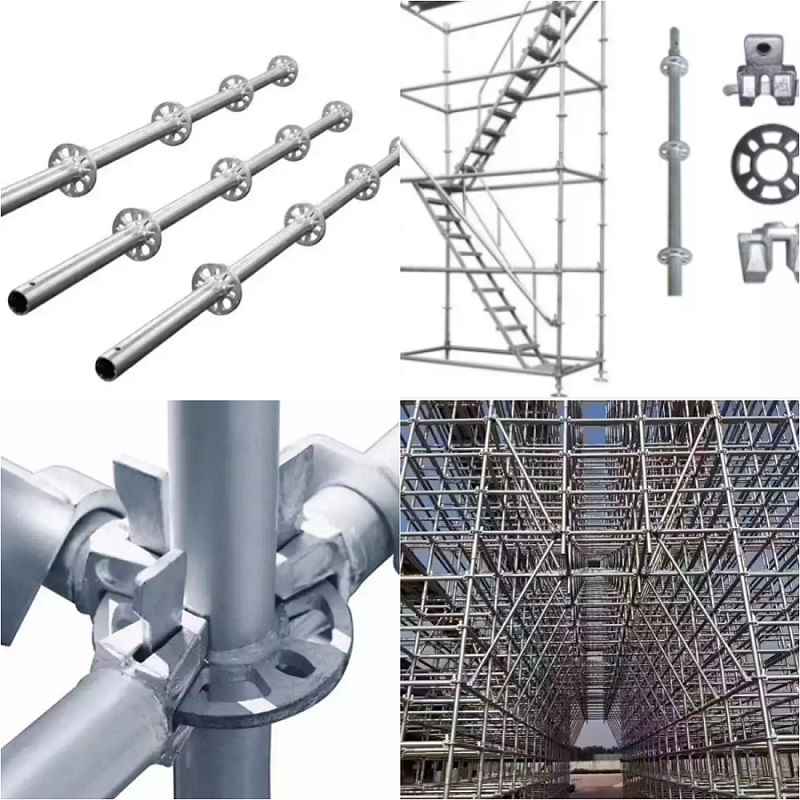
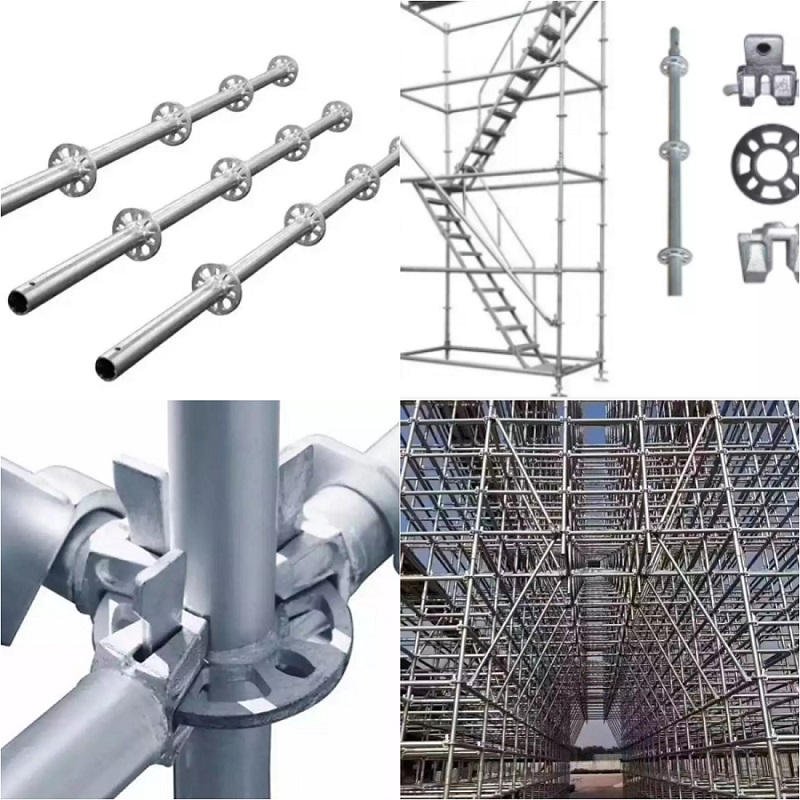
Ringlock came later as a more advanced modular scaffold structure. Its rosette node design allows multiple bracing angles, better load distribution, and stronger adaptability for circular, irregular, or high-load applications. As projects became more complex, the Scaffolding Ringlock System gained momentum because contractors wanted fewer loose parts, fewer connection errors, and more flexible geometry.
Today, the market often compares the two systems not just on cost, but on lifecycle efficiency, structural versatility, and compliance with engineering standards.
The clearest way to understand the comparison is to look at the connection, performance, and application range.
In practice, the Scaffolding Ringlock System offers more angular flexibility, which is useful when the structure is not a simple rectangle.
This is one reason the Ringlock System Scaffolding is often chosen for complex industrial maintenance where obstacles, pipe racks, and irregular geometry are common.
Ringlock typically delivers stronger node behavior because the rosette provides multi-directional connection points. Cuplock is efficient for standard applications, but ringlock is usually preferred for heavy-duty load paths and engineered structures.
For buyers specifying a Scaffolding Ringlock System, load calculations should always be verified by the project engineer and tested against relevant standards such as ASTM, DIN, or equivalent local regulations.
On busy sites, the Scaffolding Ringlock System can improve productivity because crews spend less time aligning loose components and more time erecting standardized frames and decks.
Ringlock generally has fewer loose parts than tube-and-coupler scaffolding, and its standardized components simplify inventory control. Cuplock is also modular, but ringlock’s wedge-lock mechanism often improves field efficiency and reduces the chance of installation errors.
| Feature | Cuplock Scaffolding | Ringlock Scaffolding |
|---|---|---|
| Locking system | Cup-and-blade | Rosette and wedge-head |
| Flexibility | Moderate | High |
| Geometry | Best for straight layouts | Best for complex layouts |
| Load performance | Good | Excellent in many engineered applications |
| Assembly efficiency | Fast | Very fast, especially on irregular sites |
| Common use | Slabs, façades, repetitive structures | Industrial, infrastructure, offshore, curved structures |
| Component loss risk | Moderate | Lower due to standardized node design |
When evaluating a Scaffolding Ringlock System, contractors should focus on total installed cost, not just unit price. A system that reduces rework and erection time can produce a better return even if the initial purchase price is higher.
The growing demand for the Scaffolding Ringlock System is driven by construction trends that favor modularization, safety, and speed. Large contractors and rental companies want systems that can support multiple project types without requiring a large variety of fittings.
For businesses, this translates into better labor utilization, fewer delays, and a more professional project delivery model. That is why the Ringlock System Scaffolding category is widely specified for modern high-value jobs.
A frequent mistake is assuming that all modular scaffolding is the same. It is not. The connection geometry, load behavior, and project suitability differ significantly.
Lower purchase price does not always mean lower project cost. If the structure is complex, Cuplock may require more adjustments, more accessories, and more labor hours. In those cases, the Scaffolding Ringlock System can be more economical overall.
Not true. Ringlock is used on small access platforms, temporary stair towers, refurbishment work, and industrial maintenance too. The flexibility of the Scaffolding Ringlock System makes it suitable for both compact and large-scale applications.
This is a critical error. Manufacturing precision, welding quality, galvanizing thickness, and inspection protocols matter. A reliable supplier should provide dimensional checks, weld inspection, and compliance documents under relevant standards such as ASTM or DIN. At DYNAST, key production steps are controlled with 100% inspection on critical components to help ensure consistent fit-up and site safety.
Even small variations in rosette thickness, wedge head design, or tube OD can cause compatibility issues. Before procurement, always confirm tolerances and inter-system compatibility.
A refinery contractor needed access around pipe racks, vessels, and confined equipment layouts. Cuplock would have required multiple custom adjustments, while a Scaffolding Ringlock System allowed rapid changes in bay width and brace direction. The result was shorter erection time and smoother coordination with mechanical teams.
A bridge rehabilitation project demanded suspended access, irregular spans, and load-bearing platforms. The contractor selected Ringlock System Scaffolding because the rosette node permitted flexible bracing and engineered load distribution. This improved both safety planning and installation efficiency.
For a tower façade, the main requirement was repetitive modular bays. Cuplock performed well, but the client later moved to the Scaffolding Ringlock System for future projects because the same inventory could also be used for stair towers, edge protection, and maintenance access on different building shapes.
These examples show that the best system depends on the project profile, not on brand preference alone.
To make the right decision, buyers should review more than just the catalog photo.
For procurement teams, choosing a proven Scaffolding Ringlock System supplier reduces project risk and helps ensure the system performs as intended on site.
DYNAST focuses on manufacturing consistency, engineering reliability, and responsive service. The company supports contractors, distributors, and rental businesses that need dependable modular scaffold components for repeat orders and project deployment.
When buyers compare suppliers, these operational details matter because they directly influence fit-up, safety, and productivity on site.
In simple terms, Cuplock is a strong choice for repetitive, straight-line scaffolding work, while Ringlock offers greater flexibility, broader application coverage, and stronger performance in complex or heavy-duty projects. If your work includes industrial access, curved façades, bridges, offshore structures, or mixed-use modular layouts, the Scaffolding Ringlock System is often the more strategic choice.
If you are evaluating What is the difference between Cuplock and Ringlock Scaffolding?, the answer is not just about connection style. It is about project efficiency, structural adaptability, compliance, and total lifecycle value. For more technical guidance, product selection, or a quotation, explore DYNAST’s Scaffolding Ringlock System solutions and request expert support before your next procurement decision.